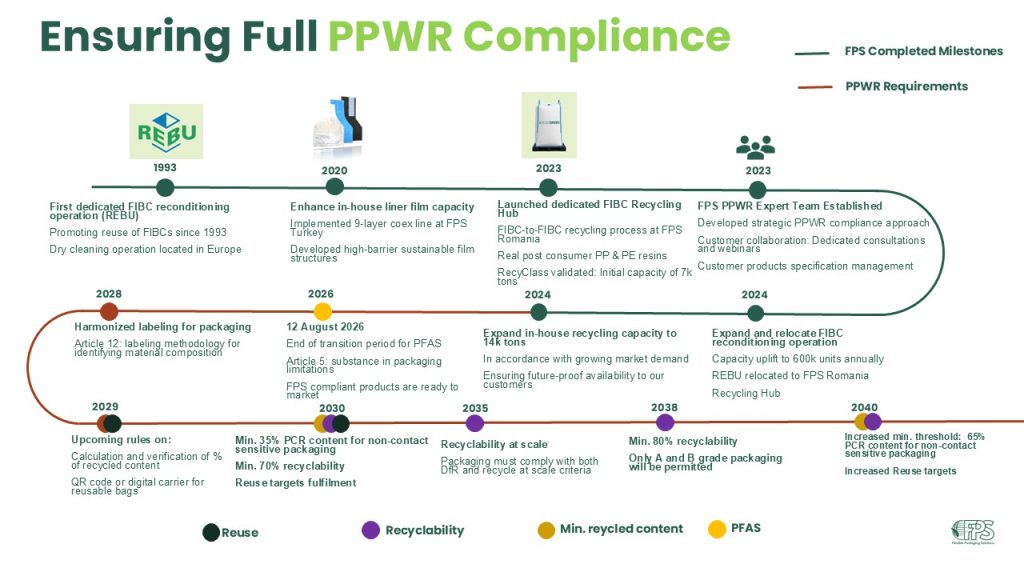
The Packaging and Packaging Waste Regulation (PPWR) is an EU regulation designed to reduce packaging waste and improve sustainability across the packaging value chain. It sets requirements for packaging to be recyclable, reusable, and made with increasing amounts of recycled content. The PPWR also aims to minimize unnecessary packaging, harmonize rules across EU member states, and support the transition to a circular economy.
The PPWR is valid for all packaging entering the EU, empty or with filling product, making this regulation applicable to all companies with exports to the EU market. Its first regulation regarding hazardous materials will be in effect on August 12th, 2026.
Not meeting the defined obligations will result in market access denial, with monetary penalties from EUR 10,000 up to EUR 200,000 depending on the governmental body imposing the fine. The PPWR is based on the principle of Extended Producer Responsibility, encouraging exporters to the EU market to collaborate with their customers in achieving shared sustainability goals.
Ultimately, the PPWR has 5 key objectives within the European packaging market:
1. Reduce virgin material use
2. Prevent and Reduce packaging waste
3. Make all non-exempt packaging recyclable by 2030
4. Safely increase the use of recycled plastics in packaging
At FPS Flexible Packaging Solutions, we actively ensure compliance to the PPWR through a variety of sustainability initiatives and scalable green solutions for our customers.
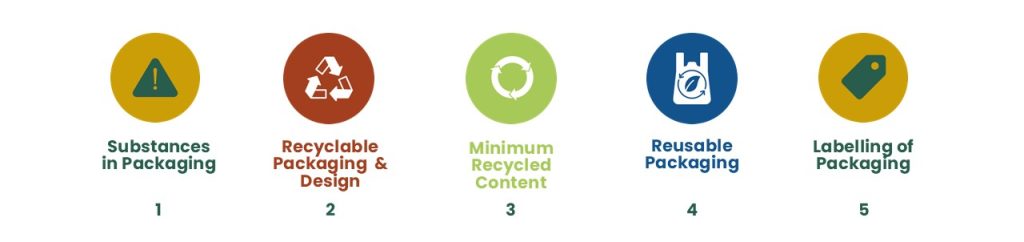
Five core requirements of PPWR for FIBCs
How is FPS compliant?
For suppliers outside the EU, all packaging related to FIBCs must comply to strict criteria under 5 core requirements, and failure to comply would risk losing access to the market of the European Union.
FPS is compliant in all 5 core requirements of the PPWR.
1. Hazardous Substances
1. =< 100mg/kg sum of lead, cadmium, mercury and hexavalent chromium
2. Restricts the use of PFAS in food contact packaging materials from August 12, 2026
PFAS
PFAS FPS compliant by 2026
Action plan to determine PFAS Presence:
– Supplier Declaration Review
– Risk Mapping
– Analytical Testing
– Documentation
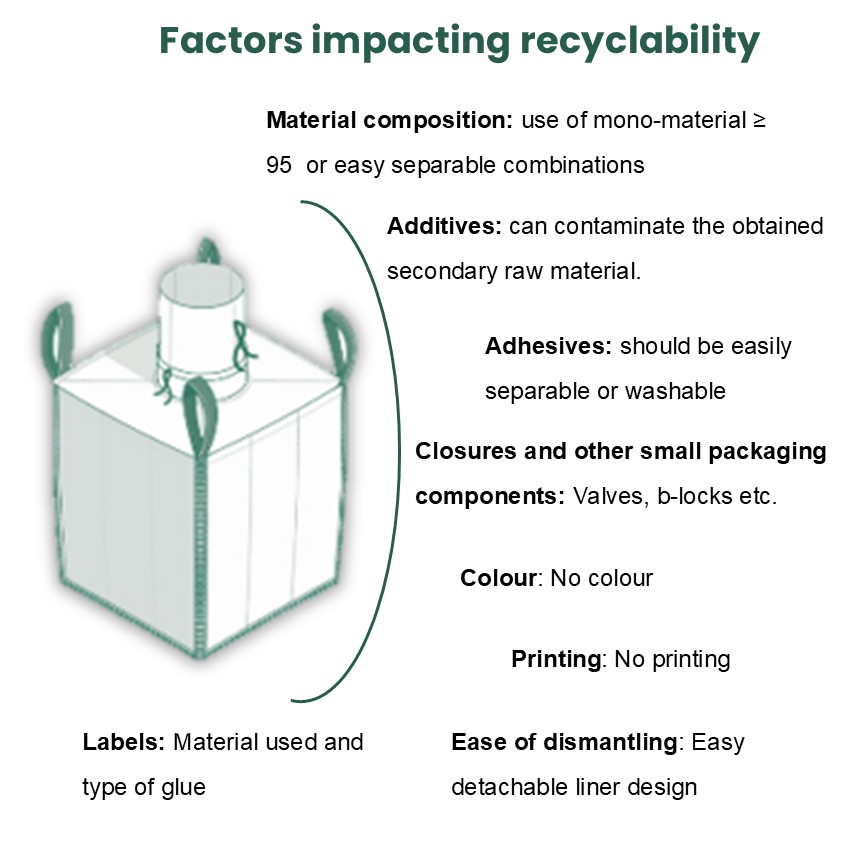
2. Design for Recycling Criteria
3. Minimum Recycled Content
By 2030, mandatory recycled content levels for plastic packaging are:
– 10% for food contact FIBCs
– 35% for all other non-exempt FIBCs
And by 2040, these thresholds increase to:
– 25% for food contact FIBCs
– 65% for all other non-exempt FIBCs
Recycled content in FIBCs must come from post-consumer recycled (PCR) plastics and this must be verifiable through independent third-party certifications such as Recyclass.
Through FPS’ Recycling Hub in Romania, which is certified by Recyclass, we have full control of PCR quality, traceability, and availability. This allows for the manufacture of the FlexiGreen FIBCs, which consists of up to 35% PCR content, and is compliant to:
– ISO 15343
– ISO 9001
– ISO 14001
– ISO 45001
4. Labelling of Packaging
1. Material Identification: Harmonized pictogram-based labels
2. Recycled content (not mandatory)
3. Prohibition of misleading labels
4. Reusable FIBCs (From 12 Feb., 2029)
By the end of 2026, the EU will have completed:
– Guidelines for harmonized label designs, containing information on material composition
– A methodology for identifying the material composition of packaging
5. FIBC Reconditioning through REBU
By 2030, all FIBCs delivered B2B in EU Member states must be 100% re-usable, with minor exceptions for UN-designated dangerous goods, as well food and feed ingredients.
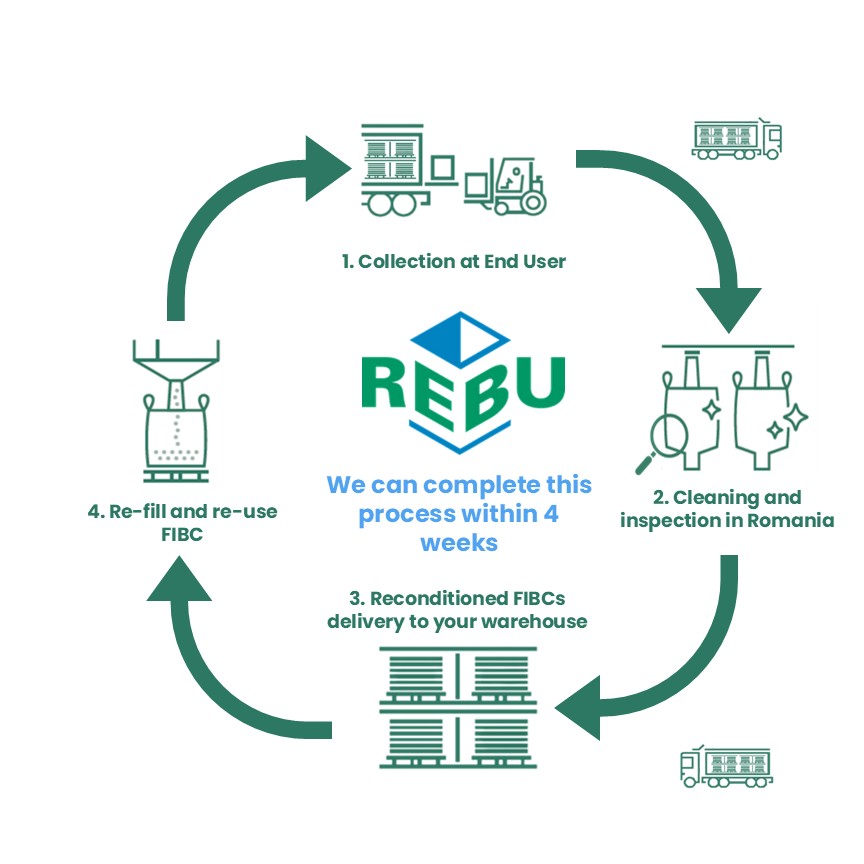
With REBU, FPS’s FIBC reconditioning operation, we provide customers with a complete circular solution. We manage used FIBC collection, refurbishment, repacking, and re-delivery, offering a seamless, convenient, and sustainable service from start to finish.
The entire process can be completed within 4 weeks, and is compliant to:
– ISO 9001
– ISO 14001
– ISO 45001
Contact us
We use cookies on our website to give you the most relevant experience by remembering your preferences and repeat visits. By clicking “Accept All”, you consent to the use of ALL the cookies. However, you may visit "Cookie Settings" to provide a controlled consent.
This website uses cookies to improve your experience while you navigate through the website. Out of these, the cookies that are categorized as necessary are stored on your browser as they are essential for the working of basic functionalities of the website. We also use third-party cookies that help us analyze and understand how you use this website. These cookies will be stored in your browser only with your consent. You also have the option to opt-out of these cookies. But opting out of some of these cookies may affect your browsing experience.
Necessary cookies are absolutely essential for the website to function properly. These cookies ensure basic functionalities and security features of the website, anonymously.
Cookie
Duration
Description
cookielawinfo-checkbox-analytics
11 months
This cookie is set by GDPR Cookie Consent plugin. The cookie is used to store the user consent for the cookies in the category "Analytics".
cookielawinfo-checkbox-functional
11 months
The cookie is set by GDPR cookie consent to record the user consent for the cookies in the category "Functional".
cookielawinfo-checkbox-necessary
11 months
This cookie is set by GDPR Cookie Consent plugin. The cookies is used to store the user consent for the cookies in the category "Necessary".
cookielawinfo-checkbox-others
11 months
This cookie is set by GDPR Cookie Consent plugin. The cookie is used to store the user consent for the cookies in the category "Other.
cookielawinfo-checkbox-performance
11 months
This cookie is set by GDPR Cookie Consent plugin. The cookie is used to store the user consent for the cookies in the category "Performance".
viewed_cookie_policy
11 months
The cookie is set by the GDPR Cookie Consent plugin and is used to store whether or not user has consented to the use of cookies. It does not store any personal data.
Functional cookies help to perform certain functionalities like sharing the content of the website on social media platforms, collect feedbacks, and other third-party features.
Performance cookies are used to understand and analyze the key performance indexes of the website which helps in delivering a better user experience for the visitors.
Analytical cookies are used to understand how visitors interact with the website. These cookies help provide information on metrics the number of visitors, bounce rate, traffic source, etc.
Advertisement cookies are used to provide visitors with relevant ads and marketing campaigns. These cookies track visitors across websites and collect information to provide customized ads.

 About FPS
  Recycling Hub